Tuesday, July 13, 2010

Nightcrawler

Pre-Marvel
Despite being one of Marvel Comics' most popular characters, Nightcrawler was originally intended for DC comics! First, Dave Cockrum (his creator) intended him to be the vicious sidekick of the Intruder. In this version, he was a real demon. But, that idea didn't work out too well. So, he created a nicer-version of Nightcrawler, who was an alien named Balshazaar for a Legion of Super Hero-spin off. But, his editor rejected the character saying he was "too funny looking". When he went Marvel Comics, they approved the idea and Nightcrawler appeared in the Giant-Size X-Men # 1.
Fictional History
Early Years
Nightcrawler was the son of Mystique (a blue-skin shape-shifter) and later revealed Azazel (mutant with demon-like appearance). Mystique threw her son into a river to save herself from a mob (that learned they were mutants). Nightcrawler was found and raise by circus people (that named him "Kurt"). He became a trapzee artist. However, one day he accidentally broke the neck of the insane Stefan. The villagers near by mistook him for a demon and tried to kill him . Xavier saved him at the last minute.
X-Men
Nightcrawler along with Storm, Cyclops, Banshee, Sunfire, Thunderbird and Colossus saved the original members of the X-Men (except Cyclops, who escaped) from a sentient, telepathic island. After being saved, the original members of the X-Men (expect Cyclops) quit the team. On Kurt's 21st birthday, Jimaine Szardos sent Kurt's soul to a simulacrum of hell. It turned out Jimaine had been masquerading as Kurt's girlfriend, Amanda Sefton. He confronted Margali Szardos, his foster mother, who held him responsible for Stefan's death. But, Kurt convinced her otherwise. He met Mystique (who he had no memory of) and was shocked by their similarities in appearance. Mystique told Kurt to ask his foster mother, Margali, about it, leaving him confused. Kurt became leader of the X-Men when Storm lost her powers. But when Cyclops and Storm (both were former leaders of the X-Men) return, he stepped down and let them decide who was in charge. Nightcrawler was injured by Nimrod and was put in a coma by the Marauders. He was sent to Muir Island to recover. When he woke, Shadowcat told them about the apparent deaths of the X-Men.
Enter: Excalibur
Nightcrawler and Shadowcat help founded the British superhero team Excalibur. Kurt finally learned that Mystique was his mother. Kurt became the leader of Excalibur and he moved Excalibur to Muir Island. He met up with Amanda Sefton, now calling herself Day Tripper. Colossus joined the team. After the team disbanded, Kurt and Shadowcat returned to America and rejoined the X-Men.
Later...
Kurt had some absences from the team, one to morn for Colossus and one to become a priest (which he gave up on). Azazel claimed he was Kurt's father and tried to use him to free himself from another dimension he was trapped in. Kurt joined Storm's X-Men squad and, when not on missions, he taught Drama to the reopened Xavier Institute's students. He left the team, because he felt unneeded (Pixie was better at teleporting than him). He went to a his home town, because they invited him to come back (supposedly to see a Nightcrawler museum), but they actually needed him to stop the monstrous Vielfras. He discovered Vielfras was actually a 16-year old that a gypsy turned into a monster. Nightcrawler sympathized Vielfras and tried to stop the townspeople from harming him, but got injured. Vielfras killed all the attackers. Nightcrawler went back to America. He was seemly killed by Bastion. However, Xavier once seemly died, but it was proven to be a hoax, so Kurt may still be alive.
Powers

  • Teleportion- Kurt's main ability. He unknowingly travels through the "Brimstone Dimension" when using this ability. He has to see where he is going when teleporting for safety reasons. He can now teleport 3 miles.
  • Wall Climbing
    Flexible Bone Structure- This allows him to be very flexible.
  • Camouflage- Kurt can blend into shadows, because of his indigo fur and light-bending attributes from the dimension he teleports to.
  • Prehensile Tail
  • Infrared Vision- His glowing eyes gives him a degree of night vision.
  • Superhuman Agility
  • Superhuman Reflexes

References:
X-Men: Ultimate Guide

http://upload.wikimedia.org/wikipedia/en/thumb/8/88/Nightcrawler.PNG/250px-Nightcrawler.PNG
http://www.nightscrawlers.com/forum/viewthread.php?tid=944 http://marvel.wikia.com/Kurt_Wagner_(Earth-616)

Sunday, July 11, 2010

Bat-Mite

This guy is Batman's most annoying fan.
Character Overview
Bat-Mite is a big Batman fan from the "Mite-Dimension" (later stories claimed he was from the fifth dimension, home of Mr. Mxyzptlk). He wears an "ill-fitting costume" and appears to be a "small childlike man". He has near-god-level reality warping via science too advanced for 3-dimensional people (like us) to understand. He idolizes the Dark Knight and sets up odd events to see his hero in action. He can, however, tell when he gets his hero mad, hence causing him to leave. He is not a super villain, but more of a super nuisance similar to Mister Mxyzptlk.
History
Pre-Crisis
Bat-Mite appeared regularly for five years in Detective Comics, Batman and World's Finest Comics (which focuses on Batman and Superman) . In World's Finest Comics, he teamed up with Superman's foe, Mister Mxyzptlk, a fifth dimensional "imp" with similar powers, four times. When the Batman comic was revamped in 1964, Bat-Mite had 3 appearances before vanishing. Later, Bat-Mite got a one-page story in The Brave and The Bold # 200.
Post-Crisis
Bat-Mite was almost completely removed from the DC Comic canon, but he did make some appearances. He got his own one-shot Mitefall (parody of Knightfall). He appeared in World's Funnest, where he and Mister Mxyzptlk destroy the pre-crisis Multiverse. Aside from World's Funnest, he had no direct connection to Mxyzptlk. In the anthology comic Bizarro Comics, in the Mxyzptlk's home dimension, the fifth dimension, there are beings similar Johnny Thunder's "lightning bolt" and Bat-Mite. In a letter column, it says Bat-Mite is from the Fifth Dimension. In Superman / Batman # 25, the Joker had fifth dimensional power (from the Emperor Joker storyline), but Bizarro removed it and it took the form of Bat-Mite. "Might" appears in Batman # 672, but this might have been a delusion. In Batman R.I.P., he appears and tries to counsel the Batman of Zur-En-Arrh, a "delusional" personality of Batman, created by Bruce in case of a mind wipe or being driven mad. In Batman # 680, he reveals to Batman he really is just a product of his imagination, but he claims imagination is the fifth dimension. In Superman / Batman # 52, Bat-Mite is seen making a bet with Mr. Mxyzptlk, similar to the one in World's Funnest.
References:

Thursday, July 8, 2010

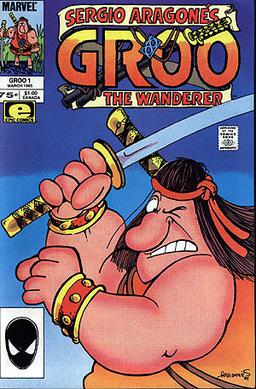
Groo the Wanderer


Character Overview
Groo is a parody of "brutal sword and sorcery heroes" (like Conan) that were popular at the time of his creation in the 70s. Groo is a buffoon, whose ignorance and stupidity causes him to misunderstand what's going on around him. The only task that he is actually good at is using his swords and he loves to use them. He has been seen battling whole armies (and always wins) with nothing more than his blades. However, he, otherwise, is actually very peaceful, making money by doing odd jobs. Due to his extreme bad luck and tendency to jump into a battle before even deciding which side he's fighting on or learning what the fight is about, he causes mass destruction. His bad luck has been so widely known, news that he's coming is enough to cause mass destruction, when people react to the pending disaster.
Other Recurring Characters


  • Captain Ahax- A captain, all too aware of Groo's effects on ships, not that it helps his sanity.
  • Arba and Dakarba- Two witches that try to take advantage of Groo with terrible results. They repeatedly lose their powers because of Groo.
  • Arcadio- A handsome warrior that takes credit for quests that he tricks Groo into doing for him.
  • Chakaal- She is a skilled female warrior. Groo is madly in love with her, but, despite her respect for him as swordsman, the feeling is not mutual.
  • Granny Groo- Groo's grandma, who tries to use Groo in her get-rich-quick-schemes that usually end badly and with her spanking Groo.
  • Grativo the Wizard- Punishes Arba and Dakarba for their failures.
  • Grooella- Groo's queen sister. She bears a resembles to Groo. She despises her brother, but sometimes helps him (usually leading to disaster). Her hair was turned black due to an accident in one of Groo's "games".
  • The Minstrel- A jester that speaks in rhyme couplets. He sings about Groo's deeds, but usually gets Groo mad. He rarely appeared in later issues due to the complexity of writing his dialogue.
  • Pal and Drumm- Two con men. Pal looks to make "easy money", but Drumm isn't too bright. Dealings with Groo have caused the people the duo is conning to get mad at them. Their names are a pun off of palindrome.
  • Pipil Khan- A conqueror that has a short-temper and an Elmer Fudd-like speech pattern. He knows about Groo causing the end of many of his conquests. Not having met Groo in person, he imagined Groo as having a more imposing appearance. When he met the man that has been haunting him so long, he died of shock.
  • Rufferto- Groo's dog. He was owned by a rich family, but left for adventure and became Groo's dog. He thinks Groo is a tactical genius and a hero. Groo thinks he is a potenial meal, but never ate him. When with Groo, Groo can safely get on a ship (a ship would normally sink because of his bad luck).
  • The Sage- A wise man that is the only person to think of Groo as a friend. He gives Groo advise that Groo misinterprets leading to even worst diasters. He is rarely seen without Mulch, his dog.
  • Taranto- A corrupt general that wants to kill Groo. Groo can never remember if Taranto is a friend or foe.
  • Weaver and Scribe- A successful writer and his right-hand man. They look suspiciously like Mark Evanier and Stan Sakai, who work on the Groo the Wanderer comic.
  • The Witch of Kaan- An eccentric hag that is always prepared with a potion for her next vistor.

Running Gags

  • Mendicant- Groo becomes mad when refered to as the latter, despite not knowing what it means.
  • Early Groo stories began with a poem and all of them ended with a moral.
  • The Minstrel's mandolin's head changes in every panel.
  • Cheese Dip- It's Groo's favorite food and when he gets money it's the first thing that comes to his head.
  • Mulch- An agricultural process often metioned in casual conversations.
  • "Did I eer?"- An understatement Groo says when he looks at the destruction he caused.
  • As mentioned before, Groo can't remember if Taranto is a friend or foe. So, Taranto takes advantage of this.
  • "I am Prince of Chichester"- Groo says this when he can't think of anything to say. His granny made him memorize this for one of her schemes. The in-joke is the editor at the time was named Daniel Chichester.
  • "What do you mean 'slow of mind'?"- Groo is called "slow of mind" and he usually responds to this later (MUCH later) in the story.
  • "What pirates?"- Pal tried to raise an reward for Rufferto by saying pirates kidnapped him (there were really none) and Drumm asked (in front of Rufferto's former owners, a king and queen) "What pirates?". He askes this from time to time, even after the con fell apart.
  • Hidden Message- In Mavrel / Epic Comic's Groo series, each issue had a secret message in the art or dialogue. The message, usually, was "This is the hidden message."
  • Creators- In every issue, four of the creators are hidden in a frame among people (soldiers, travellers, etc.)
  • Issue # 1- Due to Groo's unusual publication history, at least three Groo comic issues (all created by the original creator, Sergio Aragonés) have been numbered # 1 (partly to boost sales), so Aragonés says every issue he wrote is number 1.

References:
http://en.wikipedia.org/wiki/Groo_the_Wanderer
http://upload.wikimedia.org/wikipedia/en/d/d5/Groo_cover_issue1.jpg

Friday, June 25, 2010

DC Implosion

It wasn't a dumb crossover. It wasn't a stupid reboot. No, it was a massive cancellation of comic titles!
History
Explosion to Implosion
DC Comics did a marketing campaign between 1975 to 1978, during which 57 comic titles were premiered. This was known as "The DC Explosion". But, there was one unexpected foe who caused disastrous results: Old Man Winter! Due the Great Lakes Blizzard of 1977 and 1978, DC had extremely poor sales. For that and other economic reasons, DC has a massive cancellation of comic titles. Known as the "DC Implosion" (making fun of "The DC Explosion"), there were 65 cancellations. Also, the company had less than eight comics. Notable cancelled titles were All-Star Comics, Army at War, Aquaman, Mister Miracle, Shade the Changing Man, Black Lightning and Batman Family (which was "merged" with Detective Comics).
Cancelled Comic Cavalcade
Much of the unprinted work (that went unsold) actually did see print in Cancelled Comic Cavalcade, which had 2 issues. The content ranged from completed to uncompleted work. The original artwork was given to the rightful owners.
Reference:

Saturday, June 19, 2010

Johnny DC

Is Johnny DC a mutant or an alien? Neither, the answer he is a poorly-drawn metafictional character. In the Silver Age, Johnny DC was DC Comic's mascot that was used to promote comics. In the late 1980's, Johnny DC was the "host" of a comic promo page called "DCI with Johnny DC", which had miscellaneous DC Comic News, usually putting some comic books and creators in the spotlight and had a "partial checklist" of DC Comic titles. In the late 1990's, he appears as the main villain in the comedic, non-cannon Serigo Aragones Destroys DC, where he is delusional and thinks that the DC heroes have changed for the worst and tries to destroy the Justice League (by turning into a huge monstrous version of himself), only to be stopped by Batman. In 2004, Johnny was revamped as being a cartoon-like, mostly-silhouetted child that appears in DC Comics for 8-13 year olds. These were mostly comics based on Warner Brothers shows (Powerpuff Girls, Scooby Doo, Looney Tunes), oddly including comics based on shows based on DC Comics comics (The Batman Strikes!, Teen Titans Go!, Justice League Unlimited and Legion of Super Heroes in the 31st Century). Supposedly, Johnny edited the letters columns for these comics.
References:

Thursday, June 10, 2010

Rainbow Raider

Roy G. Bivolo wanted to become an artist... too bad he was colorblind. He would make paintings that he thought was beautiful, but everyone else thought it clashed. Roy's dad tried to cure his son's colorblindness, but due his health, he created somehow created a pair of goggles that created solid color (similar to the Green Lantern's solid light). He gave these to Roy on his deathbed. He decided to get revenge on the world that didn't like his art, by going on a crime spree and art from art galleries, saying if he couldn't enjoy them (due to his colorblindness), no one will. He clashed with the Flash and Booster Gold as well. He becomes a minor JLA foe. The villainess Blacksmith killed Roy. Rainbow Raider temporarily became a member of the zombie Black Lantern Corp. The super villain team, "the Rainbow Raiders", named themselves after Roy. It should be noted an unrelated super villain of the same name appeared in House of Mystery #167, who could change his costume color and get a different power depending on the color.
References:

Tuesday, June 8, 2010

Star Studded Comics (Fanzine)

Even though it lasted 18 issues, it had some of the super, awesome comic heroes. Larry Herndon, Buddy Saunders and Howard Keltner all were comic book fans. At some time, the three saw the other's work and realized they were all in Texas. They met, in person, at Herndon's house. Since fanzine comics were common, the three became the "Texas Trio" and create their own fanzine: Star Studded Comics. Even though it was mostly the trio's work, other comic creators joined: Roy Thomas, Grass Green, Sam Grainger and Bill Dubay. Heroes included Doctor Weird (my favorite), Xal-Kor, the Defender, Powerman (no contention to the Marvel character), the Eye and Dragonfly to a name a few. Although the comic mainly focused on the Superhero gene, some stories focused on others: the Battle of Credibility Cap (Wild West), Warrior of Llarn (Sword and Sorcery) and Wildman and Rubberoy and The Count (satire). The comic ended when Larry Herndon, Buddy Saunders and Howard Keltner decided to "move on with their lives".
References:
The Best of Star Studded Comics
http://www.billschelly.com/media/05-SSC13.jpg